Hiram Abiff in Light and Threshold
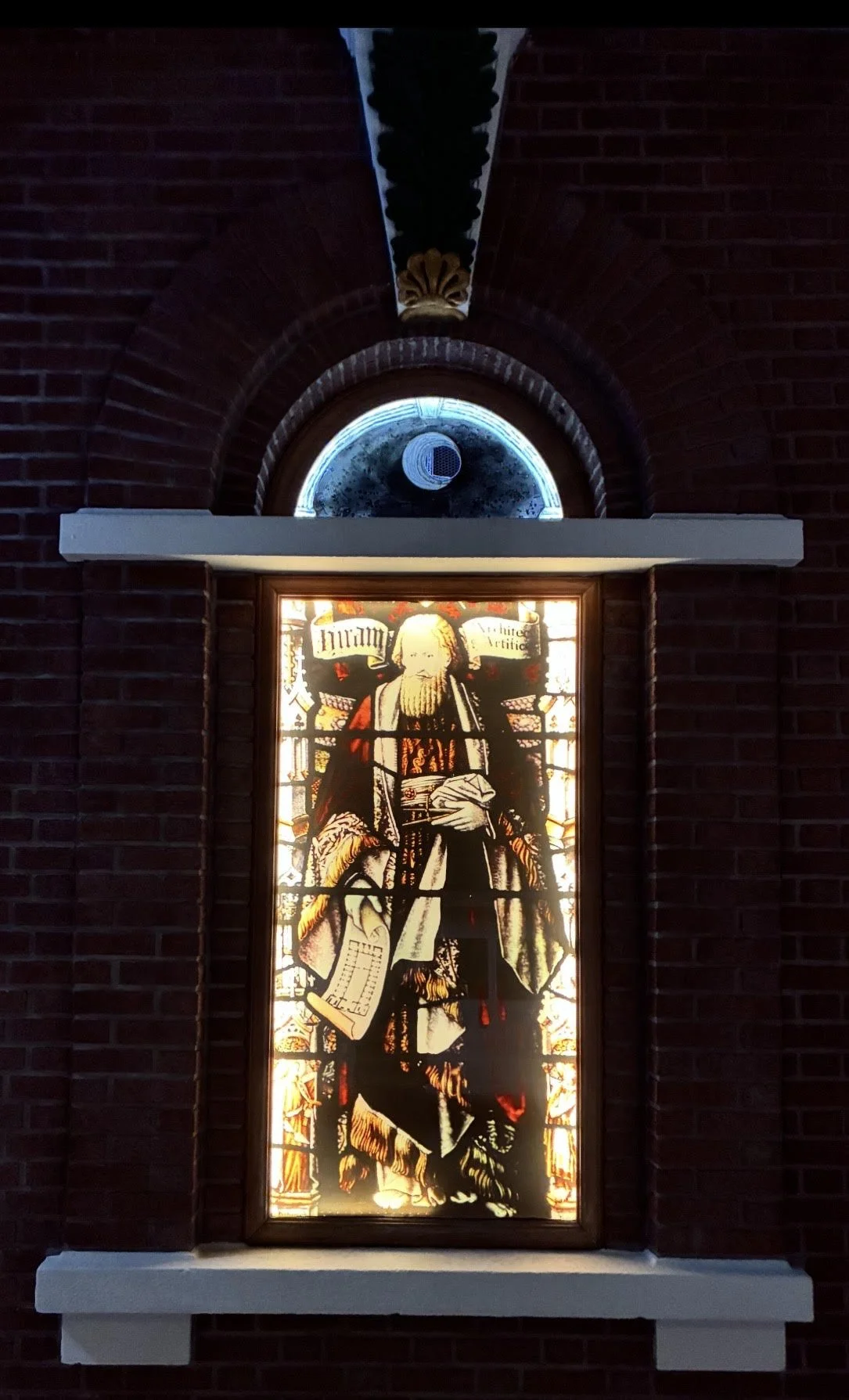
Advance Masonic Temple, right-side widow depicting Hiram Abiff
Architectural framing (what the building “does” for the glass)
Brick field as atmosphere: The surrounding brickwork reads as a deep, weighty darkness,quiet, slow, and enduring. It gives the glass something to “speak against”: brick absorbs and mutes, while the window emits.
Arch as a ritual threshold: The glass sits within a semi-circular architectural head. That arc is important: it transforms the opening into more than a “view”; it becomes a portal. At night, when the light turns the panel into a small sun, the opening feels like a passage for attention and meaning.
A “recessed lantern” effect: Notice the sequence—brick → framed recess → glass → bright glow. That layered depth makes the light feel dimensional rather than flat, as if the wall contains a chamber.
Metal/stone-like detailing at the lintel and sill: The horizontal ledges (top and bottom) create a stable base and cap; like a picture frame for something sacred. These elements also slow the eye, preventing it from racing upward with the arc.
A crown-like feature above the arch: There’s a darker decorative element above the window, centered and vertically aligned. This creates a hierarchical composition: earth (brick) → threshold (arch) → light (window) → emblem/subject (center image).
In short: the architecture frames the glass so that at night it becomes a local beacon—not just illumination, but concentration.
The stained glass (what’s visible and what it seems to be doing) At the center is a large, vertical figure rendered in illuminated stained glass: warm golds and browns with dark accents. Behind and around the figure, the composition looks busy but controlled, with decorative shapes that suggest textural richness (foliage-like forms, patterns, and darker heraldic or architectural motifs).
Even without reading every line of any micro-text, the overall visual logic is clear:
The figure is the primary light destination: Your eyes go to the face and torso first.
The palette is dominated by golden amber and burnt reds: This gives the figure a historical, commanding presence rather than purely decorative ornament.
Hints of symbolic objects or attributes appear around the figure: This is common in devotional or historical stained glass, where meaning is communicated through arrangement.
Most importantly, lighting is crucial: when the glass is lit from within (or backlit), it stops being “an image in a window” and becomes an image made of radiance. That is exactly how such works often function; not as a flat picture, but as a “machine for reverence.”
Hiram Abiff and what it might mean for Masonic symbolism You’re right that the figure is Hiram Abiff. In many Western Masonic and esoteric traditions, Hiram Abiff is associated with:
Craftsmanship and the excellence of work; the dignity of skilled labor
Instruction through building: making structure a form of moral and intellectual discipline
Order, construction, and sacred architecture: where “building” can be read as an outward sign of inner formation
In that light, what your window appears to do: especially being lit at night on a temple façade; is turn Hiram into a kind of architect of the inner life:
Craft as light: The glass literally turns meaning into illumination. Hiram is “present” as radiance, not only as iconography.
A civic beacon: At night, the temple becomes visible from afar. The glow functions as a public sign: a place where knowledge, workmanship, and order are pursued.
A threshold reminder: Because the window sits inside an arch and niche, it feels like a gate of understanding. The symbolism suggests that before entering deeper spaces, one begins with the posture of disciplined making; precision, responsibility, and steady purpose.
So what it means “for us” in a lived sense can be framed like this:
It is not only about remembering a figure from tradition, but about being reminded that building character matters as much as building bricks. The lit figure acts like an ongoing instruction: make your inner temple steady, legible, and radiant.
Why the night lighting intensifies the message Daytime: the panel is simply mounted on a wall.
Nighttime: it becomes a radiant moral image.
The darkness around it makes the stained glass feel:
more solemn
more intentional
more “otherworldly”
because your visual system is drawn to the brightest source. That contrast is often the point: it suggests a world where truth is not loud by itself; truth becomes visible when it is carried as light.
Related Articles
Glass Windows — Main Article
Glass Windows — King Solomon
Advance Masonic Temple — The Full Story