The Lions Above the Columns
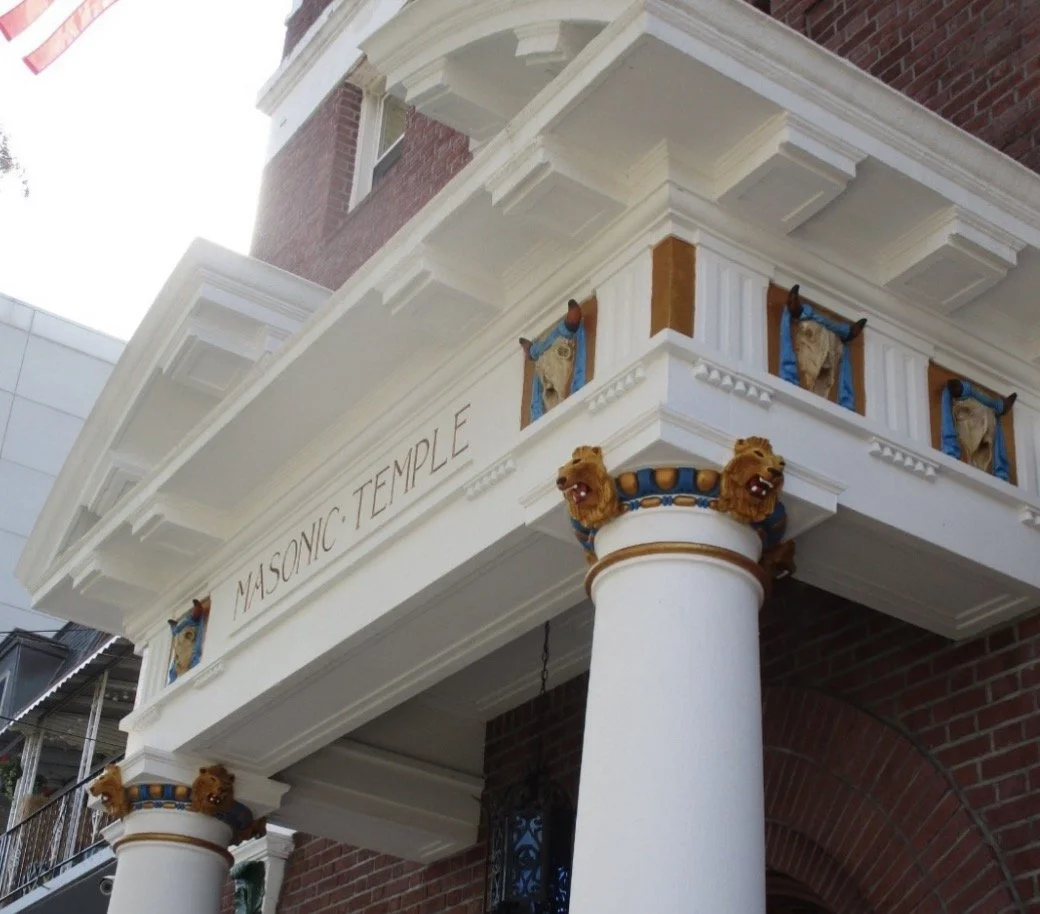
The façade of Advance Masonic Temple
Look up.
At first glance, they may seem like simple decorative figures, the kind of embellishment older buildings often carry. But lions in architecture are rarely casual. They arrive with an inheritance. Across centuries and civilizations, the lion has stood for command, courage, guardianship, sovereignty, endurance, and watchfulness. When carved into stone and placed high upon a building, it almost always means that the structure wishes to project strength not only as force, but as composure.
That is what these lions do.
They transform the columns beneath them from supports into statements. They deepen the threshold atmosphere of the temple. And they remind anyone who looks carefully that architecture once relied on symbolic figures to shape emotion before a person ever crossed the door.
Guardians in the Language of Architecture
Part of their power is immediate. Unlike more obscure symbols, the lion is legible almost instantly. Even without formal training, a viewer understands its emotional charge. The animal suggests command. It implies territory. It evokes force under control. A lion in architecture rarely appears as a wild creature in motion. More often, it is formalized, disciplined, held in poise. That transformation matters. Nature becomes emblem. Animal power becomes architectural meaning.
Placed at the top of a column, the lion takes on an even more specific role. The column is already an image of support, order, and vertical aspiration. Crown that support with a lion, and the building acquires a guardian intelligence. The structural member now ends not merely in a capital or molding, but in a figure associated with vigilance and dominion. The eye rises through the shaft and finds not abstraction, but watchfulness.
This is one reason the lions on the Advance Masonic Temple feel so appropriate to their position. They do not simply decorate the building’s upper edge. They preside over it.
Strength Made Ceremonial
Architecture often borrows the lion not to suggest violence, but to civilize power. This is a crucial distinction.
That symbolic transition is especially important for an institution like a Masonic temple. Such a building is not meant to feel reckless or theatrical. It is meant to feel disciplined, ordered, enduring, and morally weighted. The lions therefore function as a perfect architectural emblem. They suggest protection, but not panic. Authority, but not noise. Strength, but not aggression.
Their presence tells the passerby that this is a place set apart from ordinary commercial life. It is not merely a hall or meeting room. It is a ceremonial building, one that understands the façade as a kind of public face and symbolic threshold. The lions help create that effect. They make the building feel watched over, and by extension, watchful in return.
In this sense, the lions are not simply images of power. They are images of power made ethical through form.
Why Lions Belong on a Temple
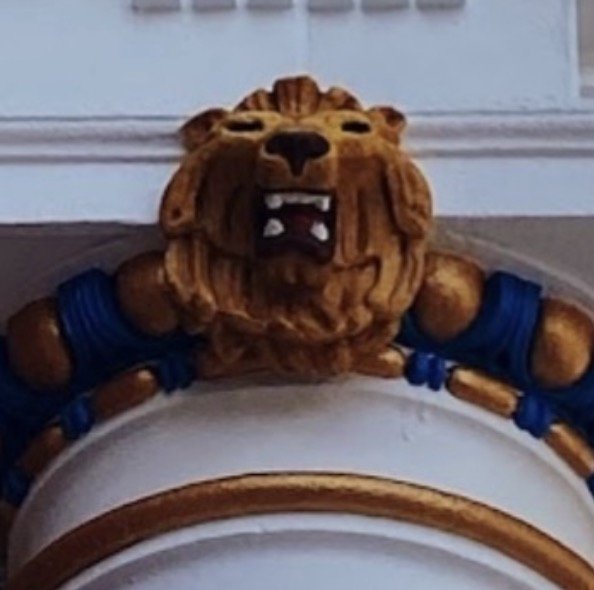
A lion on the capitol of a column on Advance Masonic Temple
A temple, whether religious, fraternal, or civic in spirit, often asks architecture to do more than shelter activity. It asks architecture to prepare the mind. It uses mass, ornament, proportion, and symbol to distinguish itself from the everyday. Lions are especially useful in this regard because they sharpen a threshold. They tell us we are approaching a place where seriousness matters.
For Freemasonry, architecture has often served as moral allegory. The language of stone, measure, craft, and elevation is central to its public visual identity. Symbols are meant not merely to decorate, but to instruct and orient. Even when a lion is not a uniquely Masonic emblem in itself, it fits naturally into a Masonic architectural setting because it reinforces qualities such buildings often seek to communicate: courage, discipline, guardianship, firmness, and dignified authority.
To place four lions atop four columns is to multiply that message. The effect is not accidental. Repetition builds force. One lion might read as flourish. Four lions read as program. They establish a rhythm of guardianship across the façade, a symmetrical field of protection and command.
The Intelligence of Repetition
There is something powerful about the fact that there are four lions, not one.
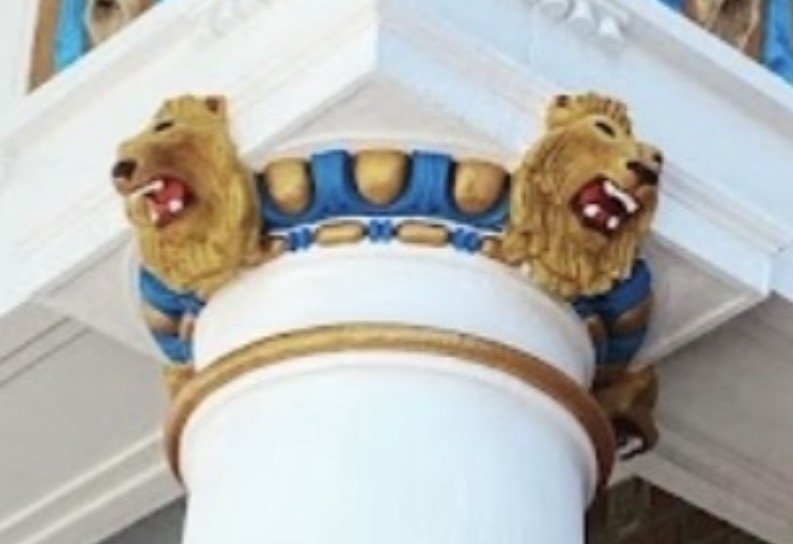
Lions liked by the egg-and-dart
The four lions on the Advance Masonic Temple do exactly that. They create a measured sequence of guardians, each reinforcing the next. Their repetition gives the façade a sense of continuity and resolve. Instead of one isolated moment of symbolic emphasis, the building sustains the theme across its front.
That has emotional impact. The viewer does not encounter a stray ornament, but a coordinated architectural idea. The lions establish a tone of vigilance and composure that extends from one column to the next. They turn the façade into a field of steadiness.
There is also a subtler effect. Because the lions are placed high above the ground, they are not encountered at the level of touch, but of upward attention. They ask the viewer to raise the gaze. This matters in ceremonial architecture. Looking up is not only visual movement; it is a bodily gesture of acknowledgment. The lions reward that gesture with a symbol equal to the ascent of the eye.
Limestone, Light, and Permanence
Material holds significance.
This makes limestone especially well suited to architectural lions. A lion must feel substantial, but not overworked; noble, but not theatrical. In limestone, the forms can remain clear and weighty without slipping into excessive drama. The stone lends gravity to the figure.
Over time, limestone also acquires a certain calm through weathering. It does not remain frozen in newness. It softens, mellows, records the passing of seasons. That aging process deepens the meaning of figures like these. Lions are symbols of endurance, and limestone itself becomes a partner in that message. The material lives through time in a way that supports the symbolism it carries.
What we see at the top of the columns, then, is not just carving. It is a union of motif, material, and civic aspiration.
The Lion as Moral Image
The lion’s significance in architecture is not purely political or protective. It is also moral.
That is especially resonant for a Masonic temple. Such a place is bound, at least in its architectural self-presentation, to ideals of discipline, seriousness, character, and the shaping of the individual through ritual and reflection. The lion, in this context, can be read not only as a guardian of the building, but as a figure of the virtues the building wishes to project.
This should not be overstated into some secret code. The lions do not require esoteric interpretation to be meaningful. Their power lies precisely in the fact that they work on both levels at once: immediately, as visible symbols of authority and guardianship; and more deeply, as moralized figures of inner strength.
They stand outside, but they point inward.
Astoria and the Afterlife of Symbol
They remind us that urban buildings were once expected to carry symbolic intelligence in public. They were not only enclosures, but teachers of mood. They created atmospheres of dignity, reverence, and order through carved details that rewarded attention. The lions on the Advance Masonic Temple are part of that older city still surviving within the present one.
And because they survive, they continue to ask something of us: not belief, necessarily, but attention. They ask us to notice that buildings can still project ideals. That ornament can still embody character. That stone can still make an argument about what deserves respect.
In a city increasingly flattened by efficiency, such details feel almost radical. They insist that institutions can still present themselves through symbolic form, and that the street can still contain moments of grandeur.
What the Lions Still Say
So what do the four limestone lions above the columns still say?
They say that guardianship can be architectural, not only literal.
They say that repetition can turn symbol into order.
They say that a temple should feel protected, dignified, and morally serious before anyone even enters it.
And perhaps most of all, they say that the older languages of architecture still survive in New York, waiting above eye level for someone to look up.
Look carefully, and the lions reveal what the building wants to be.
Not merely impressive, but steadfast.
Not merely decorative, but watchful.
Not merely old, but enduring.
Related Articles
Back To — The Entrance of the Temple
Egg and Dart — A Classic Relief
Bucranium — A Symbolic Motiff
Glass Windows — King Solomon and Hiram Abiff in color and light
Wooden Front Doors — Rich carving, bone handles, and Masonic symbolism
Advance Masonic Temple — The Full Story