Julius H. Striedinger: Quiet Craftsman, Lasting Impact
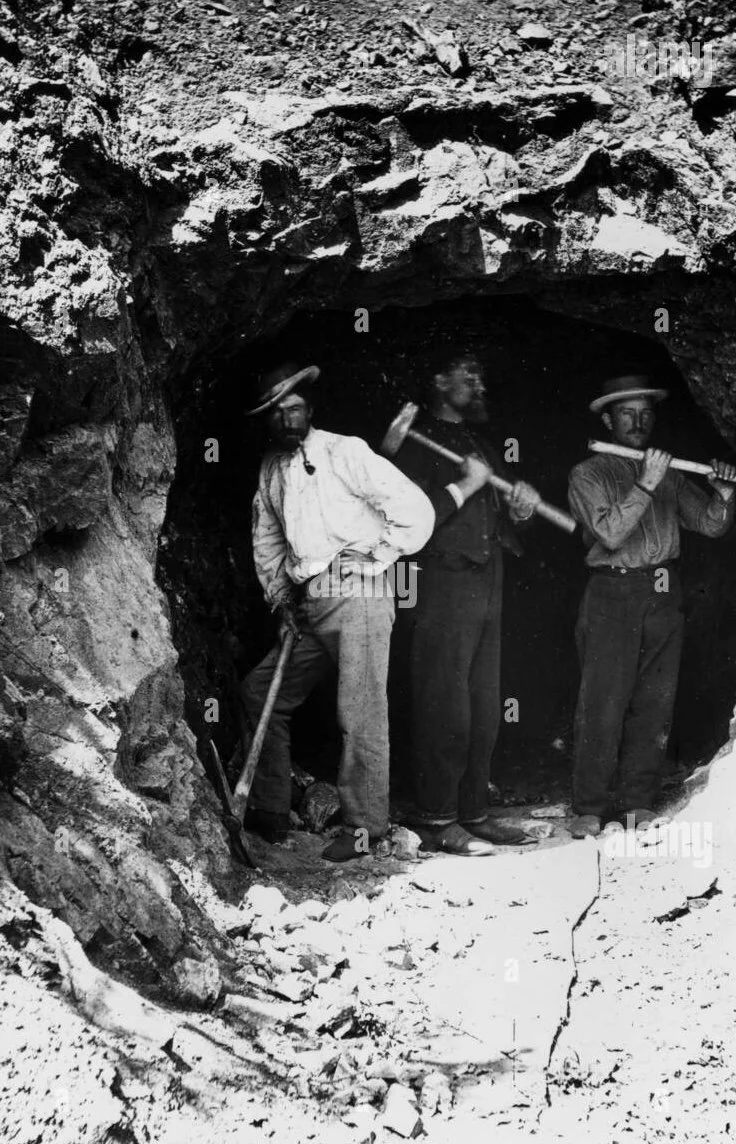
Brother Julius H. Striedinger was a civil engineer, inventor, and Master Mason of Advance Lodge No. 635 whose work helped make Hell Gate safer for navigation and Astoria more closely connected to New York’s expanding commercial world. Though little remembered today, he played a vital role in the harbor improvements, blasting innovations, and public works that helped shape modern Queens.
In the history of Astoria, Queens, and the greater East River waterfront, few men better represent the quiet discipline of civic progress than Brother Julius H. Striedinger. A civil engineer, inventor, and Master Mason of Advance Lodge No. 635, he belonged to that indispensable class of nineteenth-century builders whose names seldom entered popular memory, yet whose labor made modern urban life possible. At a time when Hell Gate remained one of the most feared passages in American waters, Striedinger helped bring order to peril and reliability to a corridor essential to New York’s commercial future.
Raised in Advance Lodge No. 635: A Brother Formed by Duty and Precision
Raised to the sublime degree of Master Mason on December 1, 1874, Striedinger carried into both lodge and public life the same virtues that marked his professional work: precision, steadiness, discipline, and devotion to the common good. His importance lies not in spectacle, but in consequence. Through surveys, reports, harbor improvements, and innovations in blasting, he helped reshape the waterways at Hallett’s Point and beyond, making navigation safer, commerce more dependable, and Astoria more firmly connected to the region’s growth.
Engineering the East River: Harbor Improvements and Public Safety
Striedinger’s mastery appeared not in grand gestures, but in method. As a civil engineer, and for a time assistant engineer to General John Newton in the War Department’s river and harbor improvement programs, his work became foundational to nineteenth-century infrastructure.
While Brother Maillefert’s innovative blasting marked the earlier phases of work at Hell Gate, later stages required more advanced methods. Here Striedinger’s estimates, surveys, and progress reports gave practical form to the effort to transform the treacherous East River into a more dependable thoroughfare.

One record credits him with helping design a channel dredged 200 feet wide and 4,700 feet long to ensure safer passage. Another points to his mastery of technical information: compiling, organizing, and clarifying the data on which reliable navigation depended.
His daily work combined field observation with drafting-room rigor. He tested depths, checked dredging operations, confirmed precise datums, and translated shifting tides and muddy riverbanks into charts, tables, and specifications. From that discipline came outsized benefits: fewer delays, less risk, steadier commerce, lower insurance costs, and reduced peril to life and property.
His reputation extended beyond New York. Records in archives such as the Hagley Museum and the Smithsonian show a man respected not for flamboyance, but for reliability. He stands as an emblem of the humble engineer whose vigilance creates the hidden framework of urban life.
Transforming Peril into Passage: Hallett’s Point and Hell Gate
Nowhere was Striedinger’s importance more apparent than at Hell Gate, the reef-strewn strait at the Astoria bend of the East River long dreaded by sailors.
Hallett’s Point was a chokehold. It wrecked vessels, raised insurance rates, and threatened regional commerce. After failed attempts to buffer dangerous rocks and after earlier private blasting efforts, Congress authorized a more systematic response, placing the task in the hands of General John Newton’s U.S. Army Corps of Engineers and assistant engineers like Striedinger.
The Hallett’s Point Works: Tunnels, Surveys, and Systematic Blasting

Rather than continue with piecemeal measures, the engineers drove ten tunnels beneath the reef, creating a lattice of boreholes for waterproof explosives. Their major breakthrough lay in the firing plan: instead of isolated blasts, they used a single simultaneous electric detonation. The 1876 explosion was both spectacle and proof that the channel could be brought under control.
Flood Rock and the 1885 Blast: Reshaping One of New York’s Most Treacherous Passages

Their ultimate target was Flood Rock, the stone island that turned tides into whirlpools and constricted one of New York’s busiest passages. Over the next nine years, crews sank a deep central shaft, ran tunnels at multiple levels, and packed ceiling drill holes with roughly 283,000 pounds of explosives to widen and deepen the channel and calm its treacherous eddies.
On October 10, 1885, the engineers flooded the mine to dampen sound and shock, then touched off what was then the largest man-made explosion prior to the atomic age. A geyser of water and rock shot 250 feet into the air as Flood Rock fractured and settled lower; the remaining outcrops were later finished with surface blasting. The shock was felt across the city and as far as Princeton, New Jersey, while an estimated 200,000 people watched from shore, commercial vessels, and private boats. As piano maker William Steinway noted in his diary that morning, “we feel the Hell Gate explosion at Flood rock, at 11.30 A.M.”
A brief point of geographic interest: Wards Island and Randall’s Island are now joined by landfill, much of it added during the 1930s Triborough Bridge project and later regrading work. The former passage between them was known as Little Hell Gate, and both are now officially part of Manhattan.
Commerce, Navigation, and Queens Growth

Although Hallett’s Cove itself remained tidal and open, this work marked the beginning of an incremental yet deliberate transformation of the shoreline. City authorities and private owners steadily extended the waterfront, building piers and bulkheads. For Queens, and for New York as a whole, the results were swift and far-reaching. Navigation became safer, shipping lanes widened, and economic growth accelerated as Queens became more closely connected to New York and New England.
These undertakings, including the deepening of the Newtown Creek inlet, the removal of dangerous rock formations throughout Hell Gate, and the shoring of the coastline from Hunters Point to College Point, alongside the soon-to-be-built Brooklyn Bridge and the Queens Borough Bridge project associated with Brothers Robert Graham and Thomas Rainey, ushered in a transformative era for commerce along the East River. At the same time, Brothers Ankener and Peter Van Alst, working through the Long Island City Improvement Commission, steadily advanced infrastructure across the area. Together, these efforts reshaped the movement of goods between Manhattan, Brooklyn, and what would become Queens. Materials traveled more easily up the East Coast to Connecticut and beyond, signaling New York’s movement toward a more unified metropolitan future and strengthening the region’s role as a critical hub in the nation’s industrial advance.
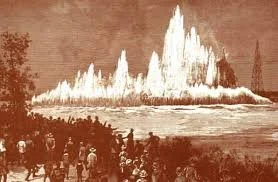
Responsibility for these sweeping changes during the final Hell Gate phase fell jointly to federal engineers and to field experts like Striedinger, whose methods became manifest in the infrastructure that would support a rapidly growing city.
For Astoria’s Masonic community, these advances were not only feats of engineering, but living examples of the fraternity’s belief that society could be improved through reason, patience, and planning.
From Astoria to Paris: Innovation on the World Stage
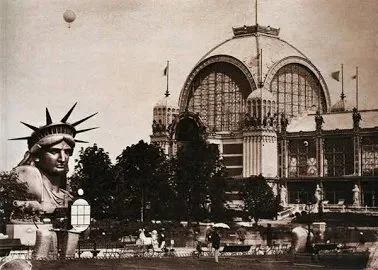
Striedinger’s influence extended beyond the United States. In 1878, he and his associate Doerflinger presented their Model of Blasting Apparatus at the Exposition Universelle in Paris. Listed as the apparatus used for the great Hell Gate explosion, it demonstrated an American method of synchronizing large charges with remarkable precision and safety.
In the same decade, Striedinger secured a U.S. patent for an “Improved Cartridge for Destroying Buildings,” intended to help fire departments create firebreaks in crowded cities. In both blasting and fire prevention, his work reflected the same principle: precision in the service of public safety.
At Paris, amid the technological optimism of the age, Striedinger’s work stood as a symbol of disciplined ingenuity. Professional journals, catalogues, and engineering circles amplified his methods, carrying his influence into broader technical and governmental practice
Patent, Invention, and Public Safety: Engineering Beyond the East River

This was the same apparatus that had helped tame Hell Gate. In the same decade, Striedinger secured a U.S. patent for an “Improved Cartridge for Destroying Buildings,” a tool intended to help fire departments create firebreaks and protect crowded cities from catastrophic blazes; a response to the hard lessons of Chicago and Boston. In both cases, his inventions served not merely to conquer obstacles, but to protect life and commerce: precision harnessed for public safety.
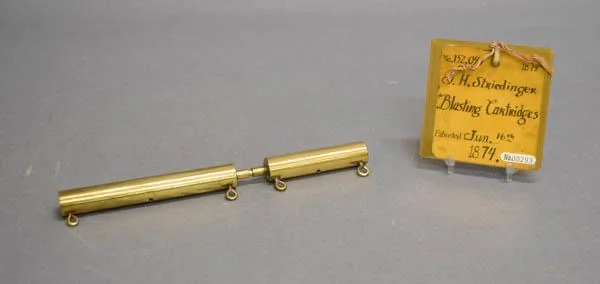
Striedinger’s Blasting Apparatus
At the Paris exposition, amid electric lights and under the gaze of international dignitaries, Striedinger’s work became a symbol of the age: bold yet measured, inventive yet humane, contributing to the wider exchange of ideas that linked continents and capitals. His methods were amplified by the American Society of Civil Engineers; his inventions marked by catalogue entries and discussed in professional journals. In presenting his work, Striedinger earned the respect of peers and the attention of officials across Europe, his ideas diffusing into policy and practice well beyond New York.
Masonic Ideals in Public Life: Order, Improvement, and Service
For our lodge, his significance is profound. Brother Striedinger embodied the Masonic virtues of order, improvement, discipline, and civic-mindedness. His life stands as a reminder that Freemasonry’s purpose is not bounded by ritual or meeting room. It extends into the labor of strengthening communities, safeguarding lives, and improving the conditions under which society prospers.
Legacy of Reliability
Brother Julius H. Striedinger stands as a foundational figure in the history of Astoria, Advance Lodge No. 635, and the making of modern New York infrastructure. He was an engineer whose careful work safeguarded lives, strengthened commerce, and brought American technical ingenuity into international view.
His example reminds us that the values of our lodge, order, discipline, improvement, and service, find their fullest meaning in labor for the public good. His legacy endures not merely in patents or archives, but in the safer waterways, stronger commerce, and steadier civic life his work helped make possible.
Related Articles
Advance Lodge No. 635 — The Full Story of the Lodge
Notable Members of Advance Lodge No. 635 — The Men behind the legacy
Advance Service Mizpah Lodge No. 586 — The Story continues here