The History and Lodge Lineage of Advance Service Mizpah Lodge No. 586
Advance Service Mizpah Lodge No. 586 unites the histories of six New York lodges across Manhattan and Queens, preserving more than 160 years of Masonic tradition in Astoria’s historic Advance Masonic Temple.
Jump to a section:
- What Is Advance Service Mizpah Lodge No. 586?
- The Early Roots: Six Lodges, Six Stories
- Consolidations That Formed Advance Service Mizpah Lodge No. 586
- Full Timeline of Lodge Lineage
- A Lodge Lineage Connecting Manhattan and Queens
- Frequently Asked Questions
- Island City Lodge Consolidation Timeline (Quick Reference)
Introduction: Where Empires Converge
There are places where history does not merely accumulate; it collides. In the shadow of Manhattan's granite towers, across the iron bridges spanning the East River, through the vanished farmlands of Queens now buried beneath brick and asphalt, there runs a thread older than the subway tunnels, older than the skyscrapers, older even than the city's consolidated boroughs themselves.
That thread is Freemasonry. And nowhere is its New York story more dramatically woven than in the lineage of Advance Service Mizpah Lodge No. 586: a Queens Masonic lodge whose history reads like a chronicle of the city itself. From the gas-lit meeting halls of Civil War-era Manhattan to the suburban temples of twentieth-century Queens, this is the story of six lodges, spanning six neighborhoods, across more than 160 years; all converging into a single brotherhood that still meets in Astoria today.
This is the history of Advance Service Mizpah Lodge No. 586: a lodge lineage unlike any other in Queens Masonic history.

What Is Advance Service Mizpah Lodge No. 586?
Advance Service Mizpah Lodge No. 586 is the living continuation of one of the most complex and historically significant Masonic consolidations in New York. Meeting on the first and third Wednesday of every month at the Advance Masonic Temple at 21-14 30th Avenue in Astoria, the lodge carries forward the traditions, rituals, and legacies of six predecessor lodges whose stories stretch back to 1856.
This is not simply a Freemason lodge in Queens. This is Freemasonry in Queens; an institution whose predecessors built temples, shaped neighborhoods, and witnessed the transformation of New York City from a collection of villages into the greatest metropolis on earth.
The Early Roots: Six Lodges, Six Stories
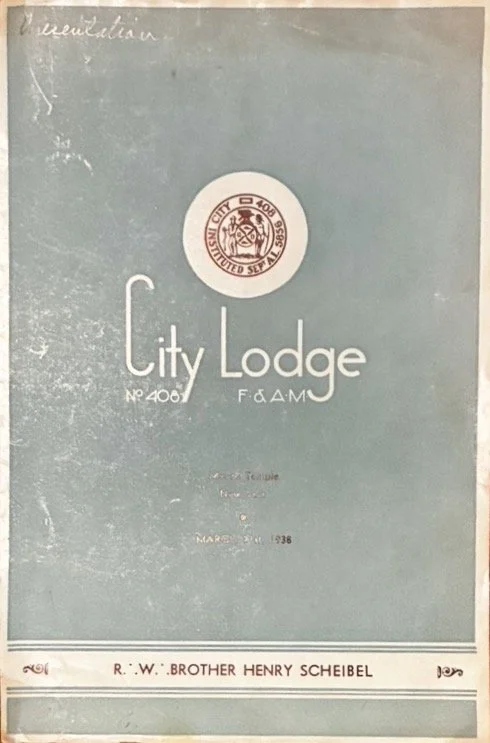
City Lodge No. 408: Manhattan, 1856
On the first of September, 1856, while the nation teetered toward civil war and New York's Five Points teemed with immigrants seeking new lives; the Grand Lodge of New York granted a charter to City Lodge No. 408.
The brothers gathered at the old Oddfellows Hall at 165-171 Grand Street, wedged between Centre and Baxter Streets in what is now the borderland between Little Italy and SoHo. Picture the scene: whale-oil lamps casting long shadows across tiled floors, men in waistcoats and top hats climbing narrow stairs to a lodge room where the ancient mysteries were transmitted in whispered solemnity. Outside, horse-drawn carriages clattered past tenement windows. Inside, merchants and craftsmen, native-born and immigrant alike, joined hands across the divides of class and creed.
For decades, City Lodge served the working men of Lower Manhattan, their Masonic work conducted against the backdrop of Civil War, Reconstruction, and the Gilded Age.
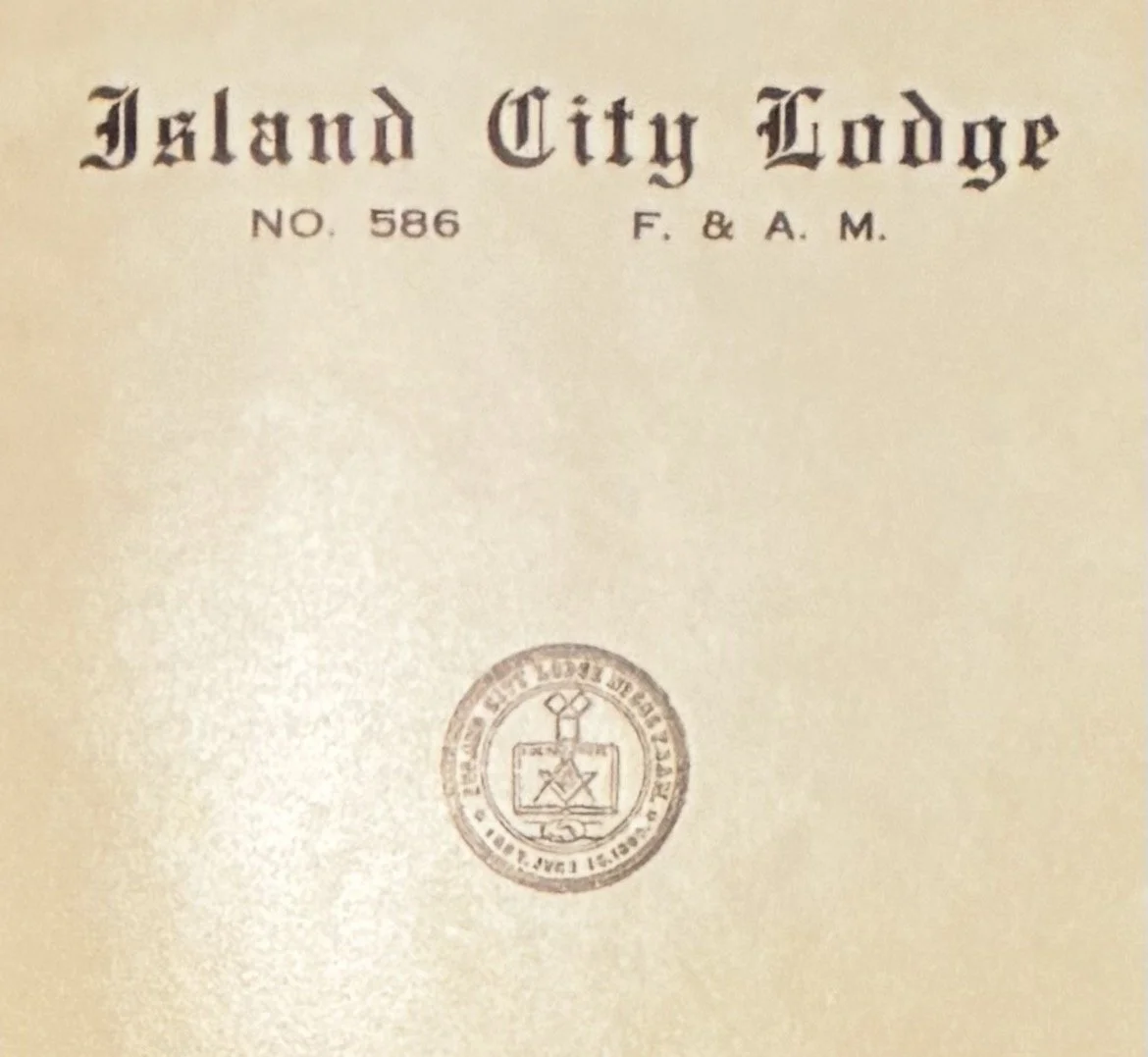
Island City Lodge No. 586: Long Island City, 1865
As the guns of the Civil War fell silent in April 1865, another lodge was being born across the East River. Island City Lodge No. 586 received its charter that same year, establishing itself in the industrial waterfront district of Long Island City; then an independent city, not yet swallowed by the consolidation that would create Greater New York in 1898.
The brothers of Island City built something remarkable: a Masonic Temple in the very heart of the Civic Center, mere feet from what would become the Queens County Federal Court Building. This was no ordinary lodge hall. The ground floor housed commercial tenants; the second floor contained the lodge room where ancient rituals unfolded; and in the basement, in a touch of American pragmatism that would have bemused the operative masons of medieval Europe, a bowling alley and full kitchen served the brothers' earthly needs.
For seventy years, this temple stood as a monument to Masonic enterprise. Then came 1938, and the temple's fate took an unexpected turn; one we shall return to shortly.
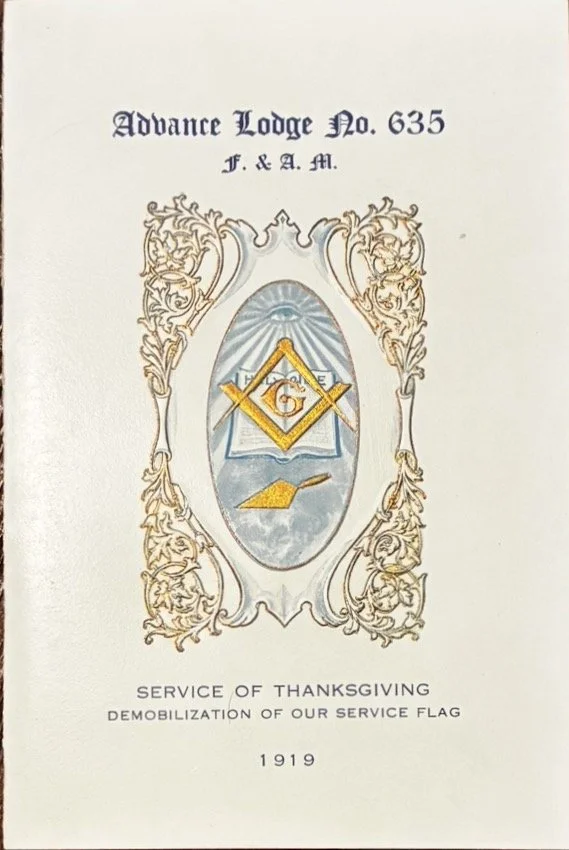
Advance Lodge No. 635: Astoria, 1867
Two years after Island City received its warrant, the village of Astoria, named, with typical New York audacity, after the fur-trading magnate John Jacob Astor, welcomed its very first Masonic lodge.
Advance Lodge No. 635 was chartered in 1867, though taken from the USS Advance, its name perhaps reflecting the optimism of a nation struggling to advance beyond the wounds of fratricidal war.
The brothers of Advance would prove themselves builders in more than the metaphorical sense. In 1916, as the Great War raged across Europe and America debated its entry, Advance Lodge completed construction of its own temple at 21-14 30th Avenue. That building still stands. It still functions as a working Masonic temple. In a city where landmarks fall to developers' wrecking balls with numbing regularity, this survival across more than a century of urban upheaval stands as testimony to the enduring nature of Masonic bonds.
Mizpah Lodge No. 738: Newtown (Elmhurst), 1873
On June 21, 1873, in a landscape that would be utterly unrecognizable to modern New Yorkers, Mizpah Lodge No. 738 received its charter in the farming village of Newtown.
Newtown. The very name evokes a vanished world; a world of apple orchards and dirt roads, of farmers driving wagons to market, of a rural Queens that existed before Robert Moses, before the subway, before the transformation that would turn farmland into the densest urban landscape outside Manhattan.
The lodge took its name from the Hebrew word Mizpah, "watchtower", a term freighted with biblical resonance, recalling the covenant between Jacob and Laban: "The Lord watch between me and thee, when we are absent one from another."
By 1920, Newtown had renamed itself Elmhurst, and the farming village had surrendered to the relentless advance of the city. That year, Mizpah Lodge dedicated its own temple, strategically positioned in what had become a central hub of Queens. The Mizpah Masonic Temple would prove magnetic to other lodges seeking a home, drawing together the threads of Queens Freemasonry for decades to come.
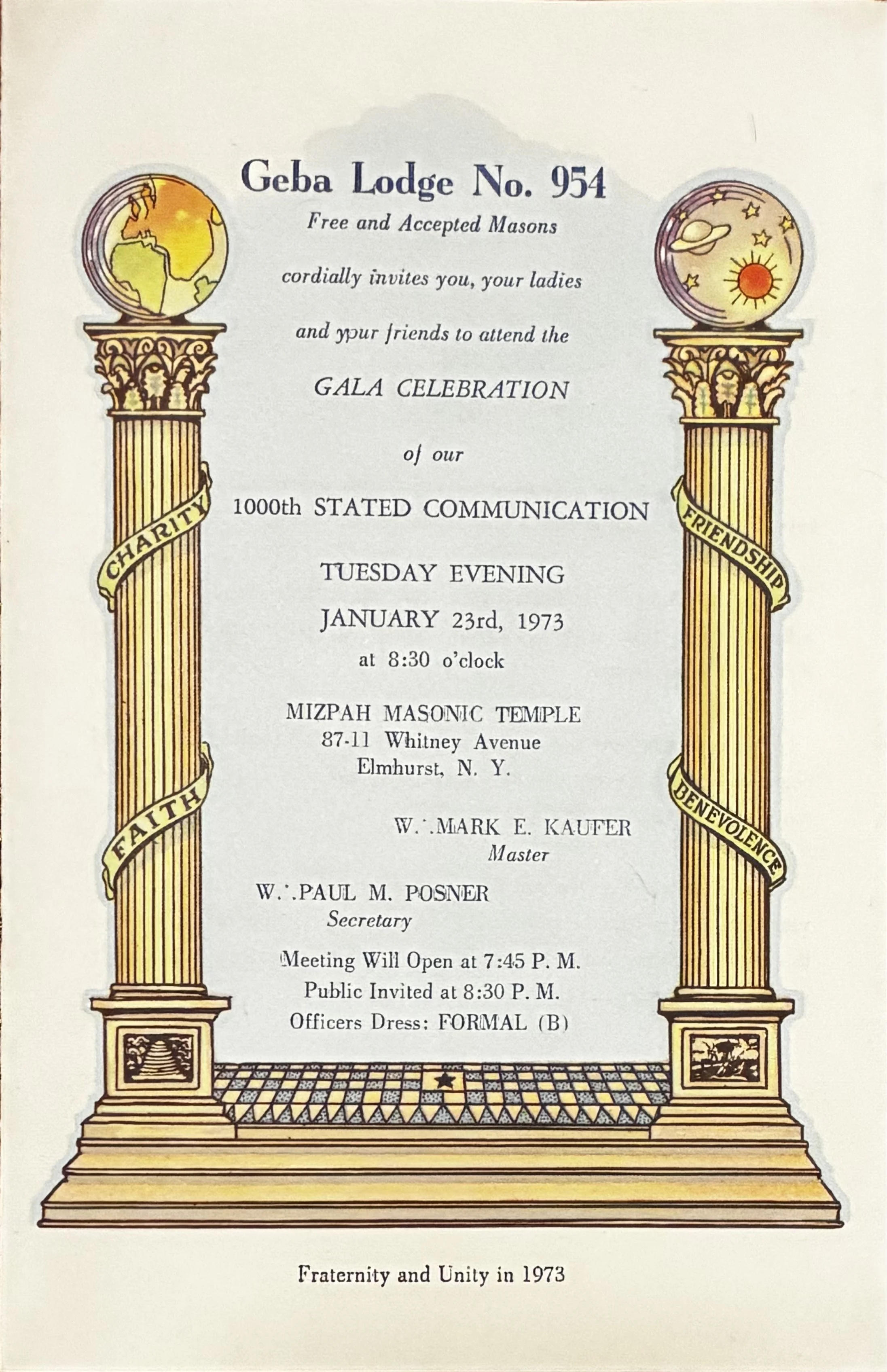
Geba Lodge No. 954: Elmhurst, 1919
As the world emerged from the cataclysm of the First World War, Geba Lodge No. 954 received its charter on May 7, 1919. The lodge established itself at the Mizpah Masonic Temple in Elmhurst, where it would work alongside other Queens lodges for more than six decades.
Geba's founding in the aftermath of global catastrophe reminds us that Freemasonry has always flourished in times of upheaval; offering men a sanctuary of order, brotherhood, and meaning amid the chaos of a changing world.
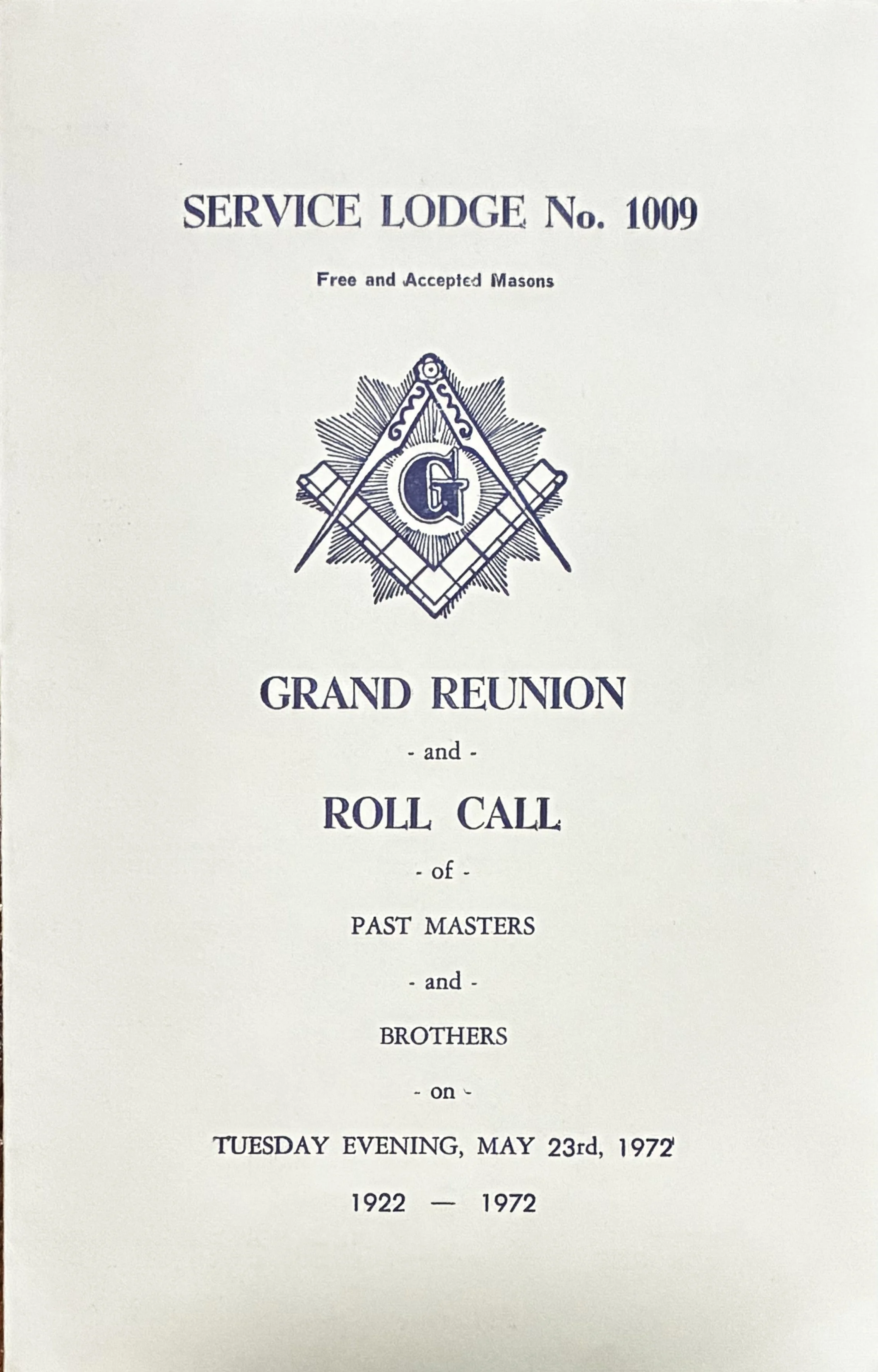
Service Lodge No. 1009: Flushing, 1923
The last of the six predecessor lodges, Service Lodge No. 1009, was chartered in Flushing in 1923; the height of the Roaring Twenties, when Queens was transforming from a patchwork of villages into a modern borough connected to Manhattan by subway lines and automobile bridges.
Flushing itself was ancient by American standards; settled by English colonists in 1645 and home to the famous Flushing Remonstrance of 1657, one of the earliest documents advocating religious tolerance in North America. It was fitting that a Masonic lodge, heir to Enlightenment ideals of tolerance and brotherhood, should plant its flag in such soil.
Consolidations That Formed Advance Service Mizpah Lodge No. 586
The story of how six lodges became one unfolds across four decades; a complex genealogy of mergers and consolidations that mirrors the demographic and social changes reshaping Queens itself.
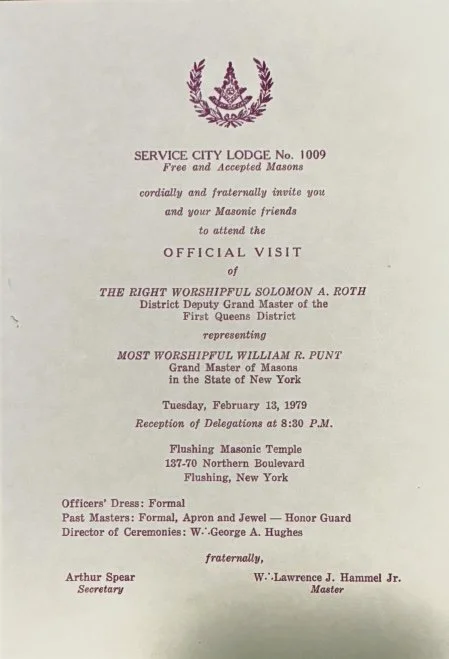
City Lodge No. 408 and Service Lodge No. 1009 Form Service City Lodge No. 1009 (1973)
The first consolidation bridged Manhattan and Queens. City Lodge No. 408, that Civil War–era brotherhood from the streets of Lower Manhattan, joined with Service Lodge No. 1009 of Flushing in 1973, forming Service City Lodge No. 1009. The consolidated lodge continued meeting in Flushing, the Manhattan brothers having followed the trajectory of the city's population northward and eastward.
Island City Lodge No. 586 and Mizpah Lodge No. 738 Form Island City Mizpah Lodge No. 586 (1987)
To understand this consolidation, we must return to Island City's remarkable temple in Long Island City's Civic Center.
In 1938, as Europe lurched toward another world war and New Deal programs reshaped American cities, the federal government approached Island City Lodge with an unusual request. The Queens County Court needed space. Could the lodge's temple serve, temporarily, as an annex?
Temporarily. That word has swallowed more than one New York institution. The "temporary" arrangement extended year after year, decade after decade, until Island City Lodge finally sold the building to the government outright. Today, more than eighty years later, the building still serves civic purposes; a silent monument to the lodge that built it.
Displaced from their architectural masterpiece, the brothers of Island City moved their meetings to the Mizpah Masonic Temple in Elmhurst. For nearly fifty years, the two lodges worked side by side under the same roof; sharing meals, sharing fellowship, sharing the ineffable bonds that unite Masons across lodge lines.
On February 12, 1987, the inevitable occurred. Island City Lodge No. 586 and Mizpah Lodge No. 738 consolidated, forming Island City Mizpah Lodge No. 586.
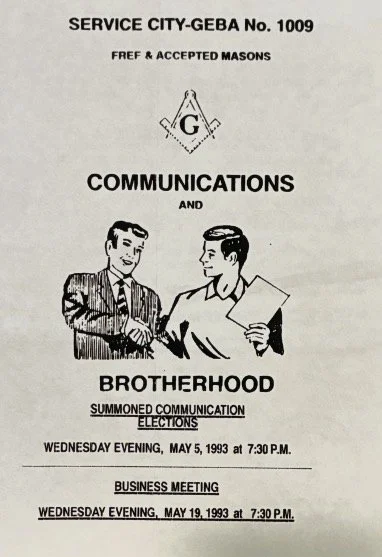
Geba Lodge No. 954 Joins Service City Lodge No. 1009 (1982)
Five years earlier, another consolidation had taken place at the Mizpah Temple. Geba Lodge No. 954, which had called the Mizpah Temple home since the 1970s, consolidated with Service City Lodge No. 1009 in 1982, forming Service City Geba Lodge No. 1009.
This merger united lodges whose roots stretched to Manhattan, Flushing, and Elmhurst; a triangulation of Masonic history across the northern reaches of New York City.
Advance Lodge No. 635 Joins Island City Mizpah Lodge No. 586 (1993)
The next consolidation brought the lineage to Astoria. On May 10, 1993, Island City Mizpah Lodge No. 586 merged with Advance Lodge No. 635, Astoria's founding Masonic lodge, to form Advance Island City Mizpah Lodge No. 586.
With this union, Mizpah Lodge sold its Elmhurst temple, and the consolidated lodge moved into the Advance Masonic Temple on 30th Avenue; the building Advance had erected in 1916. For the first time, the combined heritage of Island City, Mizpah, and Advance found a permanent home in a temple built by Masonic hands and still serving its original purpose.
Advance Island City Mizpah Lodge No. 586 and Service City Geba Lodge No. 1009 Form Advance Service Mizpah Lodge No. 586 (2018)
The final consolidation, the grand convergence of all six historical streams, occurred on January 31, 2018.
Service City Geba Lodge No. 1009and Advance Island City Mizpah Lodge No. 586joined together, forming Advance Service MIzpah Lodge no.586. The arithmetic of consolidation had reduced the lodge number, but the geometry of history had only expanded. Now a single lodge carried forward the legacies of City, Service, Geba, Mizpah, Island City, and Advance; spanning the distance from 1856 to the present day, from the streets of SoHo to the avenues of Astoria.
Full Timeline of Lodge Lineage
1856: City Lodge No. 408 chartered in Manhattan
1865:Island City Lodge No. 586 chartered in Long Island City
1867: A**dvance Lodge** No. 635 chartered in Astoria
1873: Mizpah Lodge No. 738 chartered in Newtown (Elmhurst)
1907: Island City Lodge dedicates temple in Long Island City
1916: **Advance Lodg**e completes temple at 21-14 30th Avenue, Astoria
1919: Geba Lodge No. 954 chartered in Elmhurst
1920: Mizpah Lodge dedicates temple in Elmhurst
1923: Service Lodge No. 1009 chartered in Flushing
1938: Island City Lodge sells temple to government; relocates to Mizpah Temple
1973: City Lodge No. 408 + Service Lodge No. 1009 = Service City Lodge No. 1009
1982: Service City Lodge No. 1009 + Geba Lodge No. 954 = Service City Geba Lodge No. 1009
1987: Island City Lodge No. 586 + Mizpah Lodge No. 738 = Island City Mizpah Lodge No. 586
1993: Island City Mizpah Lodge No. 586 + Advance Lodge No. 635 = Advance Island City Mizpah Lodge No. 586
2018: Advance Island City Mizpah Lodge No. 586 + Service City Geba Lodge No. 1009 = Advance Service Mizpah Lodge No. 586
A Lodge Lineage Connecting Manhattan and Queens
The geographic story of Advance Service Mizpah Lodge No. 586 is, in miniature, the story of New York City itself.
Manhattan, where it began: the island of immigrants and industry, where City Lodge No. 408 first opened its doors in the polyglot neighborhoods of Lower Manhattan.
Long Island City: industrial and ambitious, where Island City Lodge built a temple that the very government would covet.
Astoria: named for a millionaire but built by workers and tradesmen, where Advance Lodge raised a temple that still stands.
Elmhurst: once called Newtown, where farmers became suburbanites and Mizpah's watchtower surveyed the transformation.
Flushing: with its deep roots in American religious liberty, where Service Lodge carried the Masonic tradition into the twentieth century.
Each neighborhood contributed something essential to the lodge's character. From Manhattan came the cosmopolitan spirit of the great metropolis. From Long Island City came industrial ingenuity and civic ambition. From Astoria came permanence; a temple built to last. From Elmhurst came centrality, the gravitational pull that drew lodges together. From Flushing came history and continuity with the American past.
Today, when a brother sits in lodge at 21-14 30th Avenue in Astoria, he sits at the confluence of these streams; heir to traditions that span 160 years and five neighborhoods, connected by bonds both geographic and spiritual to the Masonic pioneers who came before.
Why Lodge Lineage Matters
To the uninitiated, the story of Masonic consolidations might seem like mere organizational housekeeping; bureaucratic mergers of interest only to archivists and antiquarians. Nothing could be further from the truth.
In Freemasonry, lineage is legacy.
Every lodge carries within it the accumulated wisdom, traditions, and memory of its predecessors. When lodges consolidate, they do not cancel one another out like algebraic negatives. They combine: each bringing its history, its customs, its particular way of expressing the universal Masonic truths.
The brothers of Advance Service Mizpah Lodge No. 586 are not merely members of a contemporary organization. They are custodians of a heritage stretching back to the years before the Civil War. The rituals they perform have been performed in these same lodge lineages for generations. The obligations they undertake were undertaken by brothers now long buried but not forgotten.
Consolidation is not loss. It is continuation. When lodges join together, they pool their strengths. They combine their memories. They create a larger community capable of sustaining the Masonic tradition through changing times.
This is why Queens Masonic history matters. This is why the careful tracing of lodge lineages, who merged with whom, and when, and why, is more than antiquarian curiosity. It is the work of historical preservation, of keeping faith with the brothers who came before.
Advance Service Mizpah Lodge No. 586 Today
Today, Advance Service Mizpah Lodge No. 586 meets on the first and third Wednesday of every month at the Advance Masonic Temple, 21-14 30th Avenue, Astoria, New York; the same building that Advance Lodge erected in 1916, still serving its original purpose more than a century later.
The lodge continues the Masonic work that began in 1856: initiating, passing, and raising candidates according to ancient forms, engaging in charitable works in the Queens community, and maintaining the bonds of brotherhood that have sustained Freemasonry through generations of social change.
Members come from across Queens and beyond, drawn by the lodge's rich history and its commitment to preserving Masonic traditions while remaining relevant to the present. In an age of isolation and digital distraction, the lodge offers something increasingly rare: genuine community, face-to-face fellowship, and participation in rituals unchanged across centuries.
The six lodges that preceded Advance Service Mizpah are gone, but they are not forgotten. Their memory lives in every meeting, every degree, every handshake exchanged between brothers who understand that they are links in a chain stretching back through time.
Conclusion: A Living Flame
The history of Advance Service Mizpah Lodge No. 586 is not a museum exhibit. It is a living flame; passed from hand to hand, generation to generation, lodge to lodge, across more than 160 years of New York history.
From the gas-lit hall on Grand Street where City Lodge first opened in 1856, to the bowling-alley temple of Island City, to the farmland where Mizpah kept watch over Newtown, to the enduring walls of Advance's Astoria temple; this lodge lineage represents something profound about Freemasonry in Queens, New York.
It represents continuity in a city of constant change. It represents brotherhood across the divides of neighborhood and generation. It represents the determination of free men to gather together, in every era and under every circumstance, to make themselves and their communities better.
The brothers of Advance Service Mizpah Lodge No. 586 meet today not as individuals disconnected from the past, but as inheritors of a tradition; stewards of a legacy; custodians of a flame that has burned continuously since the age of Abraham Lincoln and that, God willing, will burn for generations yet to come.
Frequently Asked Questions
What is Advance Service Mizpah Lodge No. 586?
Advance Service Mizpah Lodge No. 586 is a Masonic lodge currently meeting in Astoria, Queens, formed through a series of historic consolidations uniting six predecessor lodges with roots dating back to 1856.
How was Advance Service Mizpah Lodge No. 586 formed?
The lodge was formed on January 31, 2018, through the consolidation of Advance Island City Mizpah Lodge No. 586 and Service City Geba Lodge No. 1009; the culmination of a consolidation process that began in 1973.
Which lodges became part of Advance Service Mizpah Lodge No. 586?
Six predecessor lodges: City Lodge No. 408 (Manhattan, 1856), Island City Lodge No. 586 (Long Island City, 1865), Advance Lodge No. 635 (Astoria, 1867), Mizpah Lodge No. 738 (Elmhurst, 1873), Geba Lodge No. 954 (Elmhurst, 1919), and Service Lodge No. 1009 (Flushing, 1923).
What neighborhoods are part of the lodge's history?
The lodge's lineage connects Manhattan (SoHo/Little Italy), Long Island City, Astoria, Elmhurst, and Flushing; representing a geographic sweep across two boroughs and more than 150 years of New York history.
Why do Masonic lodges consolidate?
Lodges consolidate to combine resources, maintain viable membership levels, and preserve Masonic traditions that might otherwise be lost. Consolidation ensures continuity; merging legacies rather than ending them.
Where does Advance Service Mizpah Lodge No. 586 meet?
The lodge meets at the Advance Masonic Temple, 21-14 30th Avenue, Astoria, Queens, New York; a building erected by Advance Lodge in 1916 and still serving as a working Masonic temple today.
When does Advance Service Mizpah Lodge No. 586 meet?
The lodge meets on the first and third Wednesday of every month.
Learn more about our lodge and upcoming events at AstoriaMasons.org.
Island City Lodge Consolidation Timeline (Quick Reference)
1865: Island City Lodge No. 586 is chartered in Long Island City
1938: Island City Lodge begins meeting at Mizpah Masonic Temple in Elmhurst
February 12, 1987: Mizpah Lodge No. 738 and Island City Lodge No. 586 consolidate to form Island City Mizpah Lodge No. 586
May 10, 1993: Island City Mizpah Lodge No. 586 consolidates with Advance Lodge No. 635 to form Advance Island City Mizpah Lodge No. 586, uniting at Advance Masonic Temple in Astoria
January 31, 2018: Service City Geba Lodge No. 1009 consolidates with Advance Island City Mizpah Lodge No. 586 to form Advance Service Mizpah Lodge No. 586
Today, we meet on the 1st and 3rd Wednesdays of each month, honoring a long and distinguished Masonic history.